
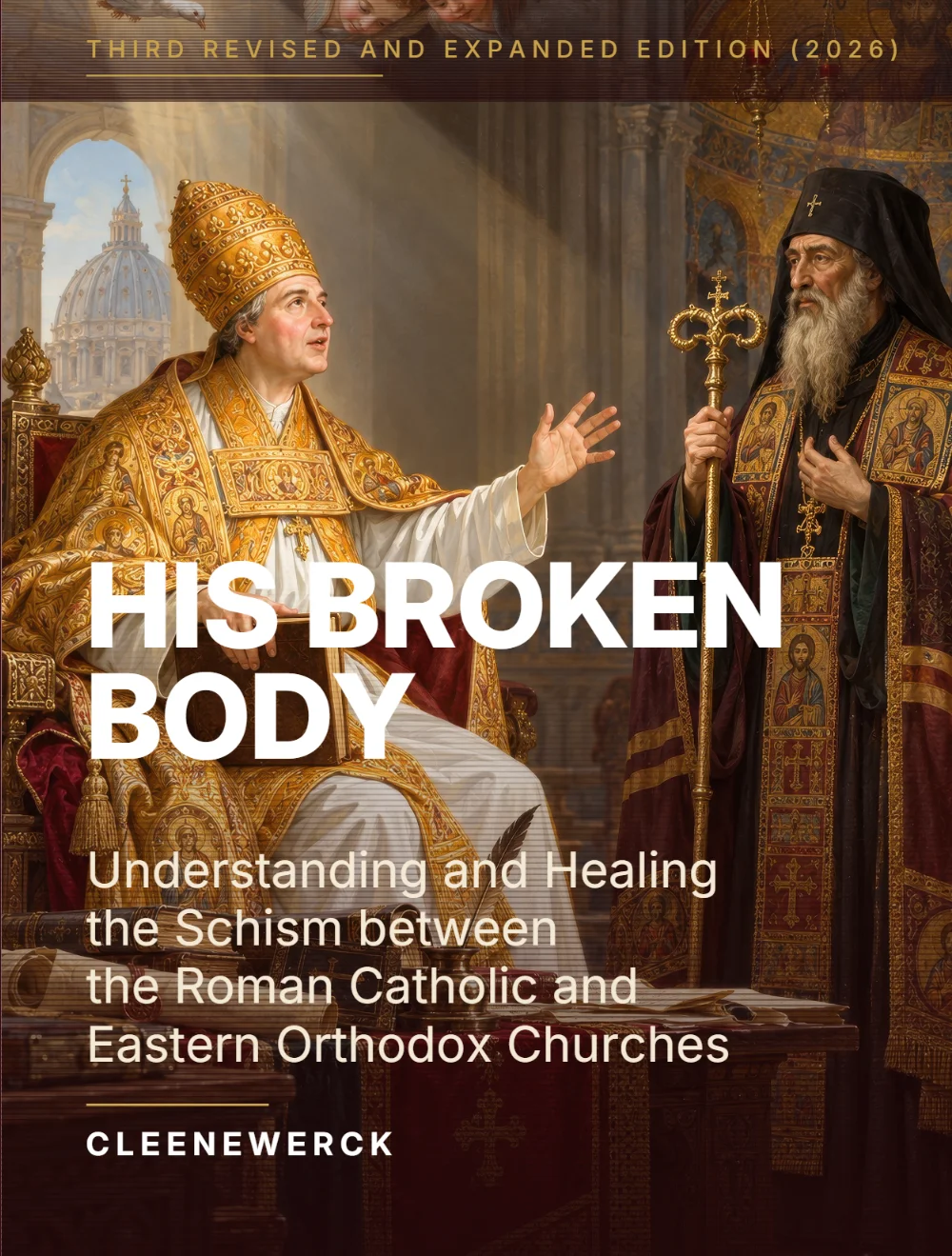
The third revised and expanded edition of His Broken Body: Understanding and Healing the Schism between the Roman Catholic and Eastern Orthodox Churches is now available from EUCLID University Press. The book first appeared in 2007 and was updated in 2013. This 2026 edition is not a light revision: it has been substantially rewritten and enlarged, and it now appears as a large-format hardcover (8.25 x 11 inches, 478 pages).
Why a new edition?
Since its first appearance, His Broken Body has tried to treat the Catholic–Orthodox question with equal seriousness toward both sides. It is written for Catholics who want to understand why the East has never accepted the papacy as Rome defines it, for Orthodox who want to understand why Rome believes what it believes, and for every reader who suspects that the usual polemics have left out most of the story.
Much has happened since 2013. The strongest recent Catholic case for the papacy, Erick Ybarra’s The Papacy (2022), deserved a careful and complete reply. At the same time, the scholarship on both sides has matured. This edition engages A. Edward Siecienski’s The Papacy and the Orthodox (2017) throughout, and it draws extensively on Patrick Truglia’s The Rise and Fall of the Papacy: An Orthodox Perspective (2023) as an Orthodox counterpoint and as a guide to the historical cases.
The book follows the evidence from the New Testament and the pre-Nicene churches through the great councils, the Photian and Gregorian turning points, Lyons, Florence and Vatican I, all the way to the official dialogue of our own day.
The argument in brief
The argument is simple to state and demanding to live. The first millennium knew a real Roman primacy, honored everywhere and obeyed nowhere outside the canons that defined it. Rome later turned that honor into a jurisdiction the East never received; the East, in turn, has allowed the primacy its own canons require to wither. Each communion holds the key to the other’s reform.
What is new in this edition
The two languages of Peter
When the Fathers of Chalcedon exclaimed that “Peter has spoken through Leo,” and when the Sixth Council said the same of Agatho, the East was speaking its own language. In the Eastern understanding, every bishop is a successor of Peter, and Rome was simply the most obviously Petrine see, since the relics of Peter rest there. Rome, for its part, tended not to realize that this was the Eastern “operating system,” and came to regard itself alone as truly Petrine, the other sees being at best apostolic. Much of the history of the schism follows from this misunderstanding.
Claim, acceptance, or courtesy: a method for the first millennium
The documents of the early centuries are full of flowery honorifics, and these have created a great deal of confusion. Drawing on Truglia, this edition proposes a simple method: we must distinguish (1) claims of authority, (2) the acceptance of those claims, and (3) the diplomatic and cultural use of exalted language addressed to all kinds of bishops. A title of honor is not, by itself, evidence of jurisdiction.
St Leo and the parting of the ways
Pope Leo the Great receives new and central attention. His statement that the figure of Peter is found in the rulers of the churches is examined in the original Latin, with the question it raises: did Leo mean Rome only, or all the churches? The edition argues that Leo does not share the view of St Cyprian that all bishops are “Peter,” and that Leo therefore marks the point where Rome and the East begin to part ways on Petrine and catholic ecclesiology.
The Latin and Greek archives of the councils
The councils of the years 400 to 900 are read in both their Latin and Greek records. This edition is also more cautious about how much these councils can prove, given the moral and political decay of the period, as the sufferings of St Maximus the Confessor and Pope St Martin make clear.
Socrates and Sozomen as witnesses
The fifth-century church historians Socrates and Sozomen are brought forward as witnesses to how the East actually understood the role of Rome in their own time.
What the medieval East was willing to concede
A new chapter asks what the Byzantine East was, in fact, prepared to grant to Rome during the medieval negotiations, and where it consistently drew the line.
Constance and the papal impasse
The Council of Constance, which ended the Western Schism, receives fresh treatment as a test case for the relationship between pope and council.
Irreformability tested
If papal teaching is irreformable, it must remain consistent across generations. The edition examines this claim against the historical record, including the reversals of earlier strict positions after Vatican II.
The Encyclical of 1848
In 1848, the Eastern patriarchs replied to Pope Pius IX with a joint encyclical. This document, often neglected, is presented as a key statement of the Orthodox position on the eve of Vatican I.
An Orthodox–Catholic cross-examination
The book closes with a cross-examination: fifteen of the hardest questions for each side, balanced so that Catholic and Orthodox readers alike are challenged.
Continuity with earlier editions
Readers of the earlier editions will recognize the familiar framework, including the hologram analogy, which is kept and now explained more fully: the analogy cuts both ways, since it can describe either a universal template or a truly whole reality present in each local church. Some readings have also been refined. For instance, St Irenaeus’s famous phrase about the church of Rome (necesse est convenire ad, Against Heresies 3.3.2) is read as most probably meaning “must have recourse to” Rome rather than “must agree with” it.
For readers who want to go further into the development of Roman primacy, From Auctoritas to Potestas (EUCLID University Press, 2026) is a companion study.